

CRM vs Marketing Automation: Why Growing Businesses Are Switching to All-in-One Platforms Like Launchera in 2026
In today’s digital business environment, one of the most common questions decision-makers ask is:
What is the difference between CRM vs marketing automation, and which one does my business actually need?
For years, businesses treated CRM and marketing automation as separate tools. One was used by sales teams, while the other supported marketing efforts.
But in 2026, this separation is quickly disappearing.
Growing businesses are shifting toward all-in-one marketing platforms that combine CRM with marketing automation into a single unified system.
This shift is not just a trend — it is a strategic evolution driven by efficiency, scalability, and customer expectations.
Let’s explore why.
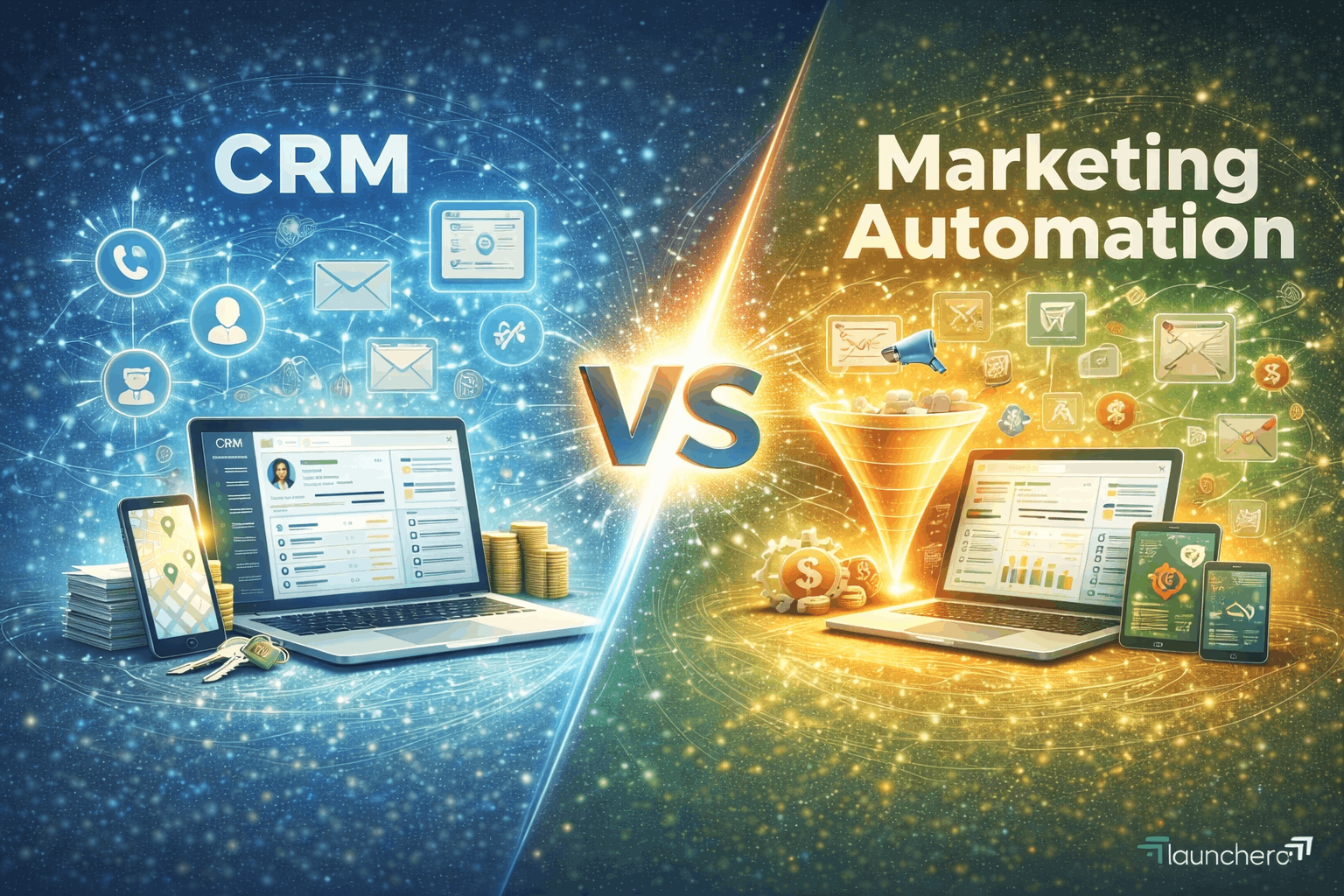
Understanding CRM vs Marketing Automation
Before we dive into why businesses are switching, it’s important to clearly understand the difference between CRM and marketing automation.
What Is CRM?
CRM stands for Customer Relationship Management.
A CRM system is primarily designed to manage interactions with customers and leads throughout the sales lifecycle.
Typical CRM functions include:
Storing customer data
Tracking communication history
Managing sales pipelines
Monitoring deal progress
Assigning tasks to team members
CRMs are traditionally used by sales teams to organize and track opportunities.
What Is Marketing Automation?
Marketing automation focuses on attracting, nurturing, and converting leads through automated campaigns.
Marketing automation software for small business typically includes:
Email campaigns
Lead nurturing workflows
Behavioral tracking
Automated messaging
Campaign analytics
These tools help marketing teams communicate consistently with prospects.
The Key Difference Between CRM and Marketing Automation
The fundamental difference between CRM and marketing automation lies in their primary purpose:
CRM manages relationships.
Marketing automation manages engagement.
CRM answers:
“Who is the customer and what is their status?”
Marketing automation answers:
“How do we communicate with the customer automatically?”
However, modern business environments demand both functions simultaneously.
Why Businesses Used Separate Tools in the Past
Historically, companies used separate systems because:
Sales and marketing teams worked independently
Technology limitations prevented integration
Automation capabilities were limited
Customer journeys were simpler
But today’s digital landscape has changed everything.
Why Separate Systems No Longer Work in 2026
Businesses in 2026 face new challenges:
Customers expect instant responses
Marketing channels have multiplied
Sales cycles are more complex
Competition is intense
Managing CRM and marketing automation separately creates serious inefficiencies.
The Biggest Problems With Separate CRM and Marketing Automation Tools
Data Silos
When CRM and marketing automation are separate, data becomes fragmented.
Sales teams lack marketing insights, and marketing teams lack real-time sales updates.
Slow Response Times
Without integration, lead handoffs between marketing and sales are delayed.
This reduces conversion chances significantly.
Manual Processes
Teams often manually transfer data between systems, leading to errors and inefficiencies.
Limited Visibility
Businesses struggle to get a complete view of customer journeys.
The Rise of All-in-One Marketing Platforms
To solve these problems, companies are adopting all-in-one marketing platforms that combine:
CRM functionality
Sales funnel management
Communication automation
This unified approach allows businesses to manage the entire customer lifecycle in one place.
What Is an All-in-One Marketing Platform?
An all-in-one marketing platform integrates multiple business functions into a single system.
Core capabilities typically include:
Lead capture funnels
CRM databases
Email and WhatsApp automation
Analytics and reporting
This eliminates the need for multiple disconnected tools.
Your competitors are replying to leads faster than you.
Launchera ensures every lead gets an instant response, automated follow-ups, and a structured sales journey — without manual effort.
👉 Book a Free Strategy Demo NowHow CRM With Marketing Automation Improves Business Performance
Combining CRM with marketing automation creates several strategic advantages.
1. Faster Lead Response
When a lead enters the system, automation can immediately trigger responses while CRM records data.
This dramatically improves response speed and conversion rates.
2. Unified Customer View
Businesses gain a 360-degree view of customer interactions across marketing and sales touchpoints.
3. Improved Lead Nurturing
Automated workflows ensure consistent communication with prospects.
4. Better Sales Pipeline Management
Sales teams receive fully qualified leads with complete engagement histories.
5. Data-Driven Decision Making
Integrated analytics provide insights into marketing performance and sales outcomes.
Why Small Businesses Especially Benefit
Marketing automation software for small business is particularly powerful when integrated with CRM.
Small businesses often face:
Limited staff
Budget constraints
Time limitations
All-in-one platforms allow them to:
Automate repetitive tasks
Reduce software costs
Improve operational efficiency
The Role of Sales Funnel and CRM Software
Sales funnel and CRM software work together to guide prospects through defined stages.
Typical funnel stages include:
Awareness
Interest
Consideration
Decision
Automation ensures prospects receive relevant communication at each stage.
How Business Automation Tools Are Changing Growth Strategies
Business automation tools now play a central role in scaling operations.
Automation enables companies to:
Reduce manual workload
Maintain consistent communication
Improve customer experiences
Increase productivity
This is why businesses are prioritizing automation-driven platforms.
Why Growing Businesses Are Switching in 2026
Several trends explain why companies are moving toward integrated solutions.
Increasing Customer Expectations
Modern customers expect immediate responses and personalized interactions.
Automation helps meet these expectations effectively.
Need for Scalability
Businesses need systems that can handle increasing lead volumes without requiring additional staff.
Cost Efficiency
Using multiple tools can be expensive.
All-in-one platforms reduce subscription costs and integration expenses.
Simplified Workflows
Unified platforms eliminate the complexity of managing multiple systems.
Launchera: A Modern All-in-One Growth Platform
Launchera represents the evolution of CRM with marketing automation.
It integrates:
CRM management
Automated communication
Workflow automation
Analytics tracking
This comprehensive approach makes it easier for businesses to manage their growth strategies.
How Launchera Combines CRM and Marketing Automation
Launchera enables businesses to:
Capture leads through funnels
Automatically respond via messaging
Track interactions within CRM
Nurture prospects using workflows
Monitor performance analytics
All within a single platform.
The Strategic Advantage of Unified Platforms
Companies using unified systems experience:
Higher conversion rates
Faster response times
Better customer engagement
Improved operational efficiency
These benefits explain the growing adoption of integrated platforms.
Future Trends in CRM and Marketing Automation
Looking ahead, key trends include:
Predictive analytics
Personalized customer journeys
Omnichannel engagement
All-in-one platforms are best positioned to support these advancements.
Conclusion
Understanding CRM vs marketing automation is essential for modern businesses.
While both systems serve important roles, the future belongs to integrated solutions.
All-in-one marketing platforms like Launchera provide a unified environment where:
Leads are captured
Relationships are managed
Engagement is automated
Performance is tracked
This integration enables businesses to operate more efficiently, respond faster, and scale sustainably.
As customer expectations and market competition continue to rise, adopting unified CRM and marketing automation systems will be a key driver of growth in 2026 and beyond.
FREQUENTLY ASKED QUESTIONS
The main difference between CRM vs marketing automation is their core purpose. A CRM focuses on managing customer relationships, sales pipelines, and lead data, while marketing automation helps businesses automate campaigns, nurture leads, and handle repetitive marketing tasks efficiently.
Yes. Small businesses benefit most when CRM and marketing automation work together. CRM helps organize leads and track interactions, while automation tools nurture those leads automatically through email, WhatsApp, and follow-up workflows.
No, a traditional CRM alone cannot replace marketing automation because it mainly manages customer data and sales processes. Marketing automation focuses on lead generation, nurturing, segmentation, and campaign automation.
Businesses are moving to all-in-one platforms because they eliminate tool fragmentation, improve collaboration between sales and marketing teams, and provide better insights into customer behavior and conversions.
Marketing automation improves conversion rates by sending instant follow-ups, personalizing communication, and nurturing leads automatically. Studies show it can increase qualified leads significantly and boost sales productivity.
Market Analysis
February 20, 2026[…] Automation […]